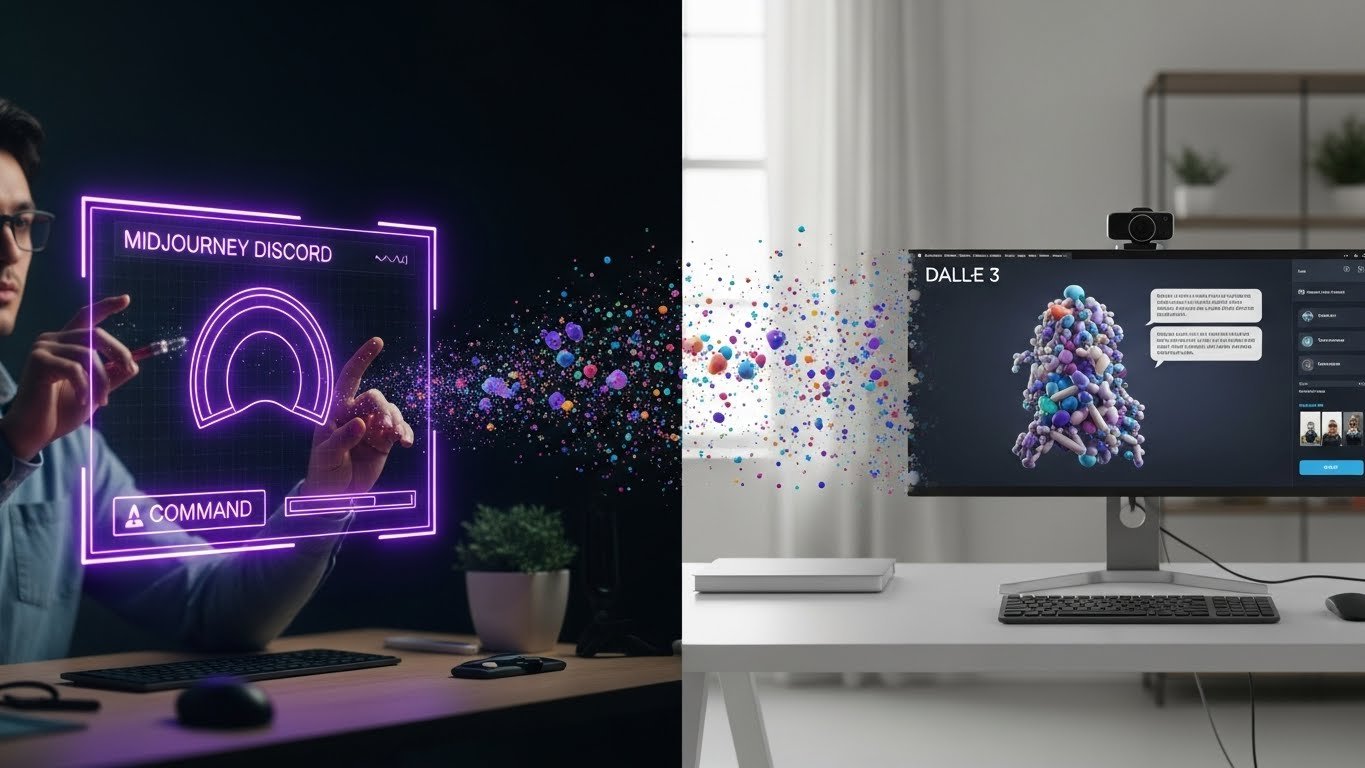
AI Image Generation Guide: Midjourney & DALL-E Explained

The landscape of digital creativity has undergone a seismic shift in recent years, driven primarily by the rapid advancement of artificial intelligence. Generative AI, specifically in the realm of text-to-image synthesis, has moved from experimental research labs to the browsers and smartphones of millions. Tools like Midjourney and OpenAI’s DALL-E have democratized art creation, allowing […]
Dailyol
Dailyol
AI Image Generation Guide: Midjourney & DALL-E Explained
AI Image Generation Guide: Midjourney & DALL-E Explained Image
SPONSORLU İÇERİK

The landscape of digital creativity has undergone a seismic shift in recent years, driven primarily by the rapid advancement of artificial intelligence. Generative AI, specifically in the realm of text-to-image synthesis, has moved from experimental research labs to the browsers and smartphones of millions. Tools like Midjourney and OpenAI’s DALL-E have democratized art creation, allowing anyone who can type a sentence to generate visuals that rival the work of professional illustrators and photographers. This guide provides a deep dive into how these powerful tools work, how to use them effectively, and the nuances that separate the two market leaders.

The Rise of Generative AI in Visual Arts

Generative AI refers to algorithms (such as Deep Learning models) that can use existing content like text, audio files, or images to create new plausible content. In the context of image generation, these models have been trained on billions of image-text pairs. When a user inputs a text prompt, the AI interprets the semantic meaning of the words and diffuses static noise into a coherent image that matches the description. This technology is not just changing how hobbyists have fun; it is revolutionizing marketing, graphic design, architectural visualization, and entertainment.

Midjourney: The Artistic Powerhouse

Midjourney has established itself as the gold standard for high-fidelity, artistic, and photorealistic output. Unlike standalone web applications, Midjourney currently operates entirely through the chat application Discord. This unique interface choice can be daunting for beginners, but it offers a community-driven approach to creation.

SPONSORLU İÇERİKGoogle Ads

How to Get Started with Midjourney

To use Midjourney, users must have a verified Discord account. After joining the official Midjourney server or inviting the Midjourney bot to a private server, the interaction begins with command lines. The primary command is the slash command followed by the prompt.

The process generally involves typing a specific command into the chat bar. The bot then processes the request and returns a grid of four variations. From this grid, users can choose to upscale a specific image to a higher resolution or create variations of one of the options if the style is correct but the composition needs adjustment. Midjourney is renowned for its specific aesthetic, often producing images with dramatic lighting, intricate textures, and a cinematic quality that feels distinctively artistic.

Advanced Midjourney Parameters

What sets Midjourney apart is its granular control through parameters. Users can append specific codes to the end of their prompts to alter the aspect ratio, the level of stylization, the chaos (randomness) of the generation, and even specific model versions. For instance, users can request anime styles, photorealistic models, or raw modes that reduce the AI’s interpretive bias. This level of control makes it the preferred tool for designers who need specific dimensions and stylistic consistency.

DALL-E 3: The Conversational Artist

Developed by OpenAI, the creators of ChatGPT, DALL-E has evolved significantly. The latest iteration, DALL-E 3, represents a major leap forward in semantic understanding and ease of use. Unlike Midjourney’s command-line interface, DALL-E 3 is integrated directly into ChatGPT for Plus users and is also available via Microsoft Copilot.

Seamless Integration and text Rendering

The primary advantage of DALL-E 3 is its ability to understand complex, conversational prompts. Users do not need to learn complex syntax or parameter codes. You can simply describe what you want in natural language. If the output is not quite right, you can converse with the AI, asking it to make specific changes, such as removing an object or changing the time of day in the image.

Furthermore, DALL-E 3 has made significant strides in rendering text within images. Historically, AI models struggled to generate legible text, often producing gibberish. DALL-E 3 can reliably render signs, labels, and speech bubbles, making it exceptionally useful for creating marketing materials, comic strips, and logos where typography is essential.

Comparative Analysis: Which Tool Should You Use?

Choosing between Midjourney and DALL-E depends largely on the user’s specific needs and technical comfort level. There are distinct differences in their output styles and user experiences.

User Interface and Accessibility

DALL-E 3 wins on accessibility. Being integrated into ChatGPT makes it intuitive for anyone familiar with chatbots. Midjourney’s reliance on Discord creates a friction point for those unfamiliar with the platform, though they are reportedly developing a standalone web interface to mitigate this.

Image Quality and Style

For pure visual fidelity and artistic flair, Midjourney generally holds the edge. It excels at textures, lighting, and creating images that look like high-end concept art or professional photography. DALL-E 3 tends to produce images that follow the prompt more literally but can sometimes have a smoother, more digital-art look unless specifically prompted otherwise.

Cost and Subscription Models

Both platforms have moved away from free tiers due to high server costs. Midjourney operates on a monthly subscription model with different tiers based on generation speed and privacy features. DALL-E 3 is typically accessed via a ChatGPT Plus subscription or through enterprise accounts, offering a suite of AI tools beyond just image generation.

The Art of Prompt Engineering

Regardless of the tool selected, the quality of the output is heavily dependent on the quality of the input. This skill is known as prompt engineering. A vague prompt will yield generic results. To get the best out of these AI models, users should structure their prompts to include specific elements.

  • Subject: Clearly define the main focus (e.g., A cyberpunk detective).
  • Action: Describe what the subject is doing (e.g., running through rain-slicked neon streets).
  • Environment: Detail the setting (e.g., futuristic Tokyo at night).
  • Lighting and Mood: Specify the atmosphere (e.g., cinematic lighting, moody, volumetric fog).
  • Style and Medium: Define the artistic look (e.g., shot on 35mm film, oil painting, digital illustration, unreal engine 5 render).

Ethical Considerations and the Future

As these tools become more powerful, ethical considerations are paramount. Issues surrounding copyright ownership, the use of artist names in prompts, and the potential for creating deepfakes or misinformation are currently being debated by lawmakers and technology ethics boards globally. Users are encouraged to label AI-generated content transparently.

Looking ahead, the integration of video generation and 3D modeling is the next frontier. We are already seeing the emergence of text-to-video models that promise to do for filmmaking what Midjourney and DALL-E have done for illustration. For now, mastering these static image generation tools provides a significant advantage in the rapidly evolving digital economy.

FAQ

Is Midjourney free to use?

Currently, Midjourney does not offer a free trial. Users must purchase a monthly subscription plan to access the image generation tools on Discord.

Can DALL-E 3 create images with accurate text?

Yes, one of the major improvements in DALL-E 3 is its ability to render legible text, such as signs and labels, much more accurately than previous AI models.

Do I own the copyright to images created with AI?

Copyright laws regarding AI-generated art are currently complex and vary by country. In the US, for example, purely AI-generated works currently cannot be copyrighted, but this is an evolving legal landscape.

SPONSORLU İÇERİK

💬 Yorumlar

Güvenli yorum alanı

💬

Henüz yorum yapılmamış. İlk yorumu siz yazın.

Beyond the Hype: Could an “Elon Musk Party” Actually Gain Traction in America?

You’ve seen him launch rockets, revolutionize electric cars, and take over Twitter (now X). But could Elon Musk’s next venture be a political party? It’s a question that seems to be on more minds than you might think. A recent poll reveals that a surprising slice of the American electorate—14 percent, to be exact—would consider […]
Dailyol
Dailyol
SPONSORLU İÇERİK

You’ve seen him launch rockets, revolutionize electric cars, and take over Twitter (now X). But could Elon Musk’s next venture be a political party? It’s a question that seems to be on more minds than you might think. A recent poll reveals that a surprising slice of the American electorate—14 percent, to be exact—would consider throwing their support behind a hypothetical “America Party” led by the tech mogul.

While it’s far from a political earthquake, this number isn’t insignificant. It points to a growing frustration with the traditional two-party system and a yearning for something different. Let’s dive into what this really means and whether a Musk-led political movement is anything more than a fascinating “what if.”

Tapping into the Politically Homeless

Imagine the current political landscape as a two-way street with traffic perpetually jammed. Many voters feel stuck, believing that neither the Democratic nor Republican parties truly represent their views. They see a system bogged down by partisan infighting and a focus on issues that don’t align with their priorities.

SPONSORLU İÇERİKGoogle Ads

This is where the idea of a third party becomes so appealing. It offers a potential off-ramp—a path for those who identify as “fiscally conservative and socially liberal.” Musk himself has described his own political leanings this way, striking a chord with moderate voters who feel left behind by the increasingly polarized platforms of the two major parties. The poll shows this group, particularly self-described moderates and independents, is most intrigued by the prospect of a new, centrist option.

The Power of Personality and Profile

Let’s be clear: a significant part of this appeal is tied directly to Elon Musk himself. He’s a larger-than-life figure who has built a reputation as a problem-solver and an innovator who gets things done. For those tired of what they see as empty promises from career politicians, Musk’s brand of high-octane, results-driven leadership is incredibly attractive.

His constant engagement on social media and willingness to challenge the status quo have cultivated a loyal following. This isn’t just about policy; it’s about a belief that an outsider with a track record of disrupting entire industries could be the one to finally shake up Washington.

The Steep Uphill Battle for Any Third Party

However, history gives us a serious reality check. The American political system is a fortress designed to support two major parties. From ballot access laws and fundraising networks to media coverage, the deck is heavily stacked against newcomers.

Think of it as a startup trying to compete with industry giants like Apple and Google overnight. It’s not impossible, but the hurdles are immense. While 14% is a notable starting point for a party that doesn’t even exist, converting that initial curiosity into votes, volunteers, and a nationwide political infrastructure is a monumental task. The last time a third-party candidate made a significant impact was nearly three decades ago.

So, while the idea of an “America Party” led by one of the world’s most famous innovators is compelling, it’s best viewed as a symptom of a deeper issue: a widespread hunger for change and a dissatisfaction with the choices on offer. For now, it remains a powerful symbol of voter frustration rather than a looming political reality.

SPONSORLU İÇERİK

Forget the iPhone 17 PRO MAX Xiaomi’s New Flagship is Packing an Extra Screen and a Battery So Big, It’s Almost Ridiculous

Apple just dropped its iPhone 17 series, and sure, they look sleek. But over in Xiaomi-land, they’re not just playing catch-up; they’re inventing a whole new game. The buzz around the new Xiaomi 17 Pro Max isn’t just about another high-end phone – it’s about two jaw-dropping features that make you wonder if Apple’s been […]
Dailyol
Dailyol
SPONSORLU İÇERİK

Apple just dropped its iPhone 17 series, and sure, they look sleek. But over in Xiaomi-land, they’re not just playing catch-up; they’re inventing a whole new game. The buzz around the new Xiaomi 17 Pro Max isn’t just about another high-end phone – it’s about two jaw-dropping features that make you wonder if Apple’s been napping: a legitimate extra screen on the back and a battery so huge it laughs at your power bank. Is this Xiaomi’s moment to truly challenge the iPhone’s crown? Let’s dive in.

1. Two Screens Are Better Than One: Xiaomi’s Back-Display Bonanza

  • What’s the Big Deal?Imagine a world where the back of your phone isn’t just a canvas for fingerprints and camera lenses. The Xiaomi 17 Pro Max dares to imagine precisely that, equipping its rear with a fully functional secondary screen. It’s a bold proposition – a fundamental rethinking of how we interact with our devices.
  • A Trip Down Memory Lane (Xiaomi Edition):The seeds of this idea weren’t sown overnight. Xiaomi first flirted with the concept back in 2021 with the Mi 11 Ultra, which featured a diminutive 1.1-inch AMOLED display beside the cameras. While primarily intended for enhanced selfies using the superior rear cameras and quick notification glances, it felt like a tantalizing glimpse into a potential future. Then, silence. The following iterations, the Mi 12S Ultra and Mi 13 Ultra, conspicuously lacked this feature, leaving many to wonder if it was merely a passing fancy, a technological dalliance. But Xiaomi’s patents, showcasing designs for wrap-around and sliding screens, suggested a deeper, more sustained interest.
  • The Comeback Kid: Xiaomi 17 Pro Max’s “Magic Back Screen”Now, the prodigal screen returns, reborn and amplified on the Xiaomi 17 Pro Max. Dubbed the “Dynamic Back Display” or, more playfully, the “Magic Back Screen,” this isn’t a token gesture. We’re talking about a 2.9-inch, high-resolution, 120Hz AMOLED panel. This is a screen meant to be used.It’s not just for vanity shots, though high-quality rear-camera selfies are undoubtedly a perk. The screen serves as a hub for music controls, interactive widgets, and even countdown timers. And, in a stroke of nostalgic genius, Xiaomi is offering a special Game Boy-esque case that enables light gaming on the rear display.
  • Gimmick or Genius? The Great Screen DebateThis is where things get interesting. The possibilities are undeniably exciting: unparalleled selfie quality, glancing at information without fully engaging with your phone, and a healthy dose of “wow” factor.However, legitimate concerns arise. Does this added screen compromise the phone’s sleekness? Does it introduce another vulnerable surface prone to cracking? Will developers embrace this feature, or will it languish as a novelty? And, perhaps most practically, how will one find a case that adequately protects this dual-screen marvel?
  • How Apple Compares (or Doesn’t):Apple has favored a more subtle approach to expanding screen functionality. The Dynamic Island, that clever morphing notch, and the Always-On display represent Apple’s incremental, software-driven additions. The most significant “external screen” speculation revolves around the long-rumored foldable iPhone (iPhone Fold), anticipated in 2026, which would necessitate a cover screen. Xiaomi is challenging the status quo now.

2. The Unholy Power: A Battery That Just Won’t Quit

  • Why So Big?In our hyper-connected world, our smartphones are demanding mistresses. Their vibrant displays, lightning-fast processors, and ubiquitous 5G connectivity drain power with alarming alacrity. A bigger battery isn’t a perk; it’s an increasingly vital necessity.
  • Xiaomi’s History of Power-Pushing:Xiaomi has been a relentless innovator in battery technology and charging speeds. From the relatively modest 18W charging on the Mi 3 in 2013, they rapidly escalated.Who can forget the 120W HyperCharge on the Mi 10 Ultra (2020)? It could replenish a 4500 mAh battery in under 30 minutes. Then, they demonstrated 200W wired charging (a full charge in a blistering 8 minutes) and a mind-boggling 300W (4100mAh in 5 minutes!). These feats pushed the very boundaries of what we considered feasible.
  • Xiaomi 17 Pro Max: Battery Behemoth!The Xiaomi 17 Pro Max doesn’t simply offer a large battery; it boasts a gargantuan 7,500 mAh cell. This is not just “big”; it’s verging on the absurd, promising battery life that could potentially span days. The standard Xiaomi 17 and 17 Pro don’t slouch either, offering 7,000 mAh and 6,300 mAh, respectively.The Pro Max supports 100W wired charging and 50W wireless charging. And, a notable feature – the series uses silicon-carbon batteries and the Surge Battery tech which contains a G2 management chip.
  • The Dark Side of Power: Trade-offs & WorriesFast charging, while convenient, places stress on battery chemistry. Xiaomi acknowledged that their 200W technology resulted in a 20% degradation after 800 cycles. And, like the vast majority of modern smartphones, the batteries are non-removable, contributing to e-waste.The most immediate concern is bulk. Can a 7,500 mAh battery be integrated into a sleek phone without transforming it into an unwieldy brick? Xiaomi asserts that the 17 series maintains a slim 8mm profile, so the company has definitely optimized.
  • Apple’s Battery Game:The iPhone 17 Pro Max features Apple’s largest battery to date, clocking in at 5,088 mAh. While a significant upgrade, it remains considerably smaller than Xiaomi’s offering.Apple’s charging speeds, while improved, still lag behind Xiaomi’s aggressive rates. Apple prioritizes software optimization (Adaptive Power, battery health monitoring) and energy-efficient chips.

3. Clash of the Titans: Xiaomi vs. Apple in the High-End Ring

  • Apple’s Playbook:Apple’s strength lies in its refined design, seamless ecosystem, and a user experience predicated on the principle that “it just works.” They typically introduce features only when they are thoroughly polished, relying on brand loyalty.
  • Xiaomi’s Gauntlet:Xiaomi adopts a different tack: aggressive innovation, pushing the envelope with cutting-edge technology, often at more competitive price points. Their sights are set squarely on Apple’s premium market, and their recent growth in high-end shipments indicates that this strategy is resonating with consumers.
  • The Core Question:Is Xiaomi merely engaging in a “spec war,” or are these features genuinely enhancing the user experience? Is Apple playing it too cautiously, or is its focus on seamless integration ultimately more impactful?

4. The Future is Now (and Beyond)!

  • More Screens Everywhere:Xiaomi will continue to refine its rear display, possibly enabling full-screen applications or more sophisticated interactive widgets.Apple’s foldable iPhone will inevitably inject new life into the “two-screen” conversation. The lines between “secondary” and “cover” screens will inevitably blur.
  • Battery Revolution:Xiaomi is already deeply invested in silicon-carbon batteries. Solid-state batteries, currently being developed for their electric vehicles, may eventually find their way into smartphones, promising even higher energy densities and faster, safer charging.Apple is also exploring new battery materials. Solid-state battery rumors continue to surface.
  • The Unending Race:The pursuit of greater screen real estate, longer battery life, and faster charging will never cease. AI will play an increasingly pivotal role in optimizing every aspect of our devices, enhancing efficiency.

So, Should You “Forget the iPhone 17”?

The Xiaomi 17 Pro Max is a serious contender, boasting a versatile secondary screen and a battery that promises unrivaled endurance. If you’re seeking cutting-edge technology and liberation from charging anxiety, Xiaomi presents a compelling argument. The iPhone 17 will undoubtedly offer a refined experience, but Xiaomi is making its case as the bolder, more experimental innovator.

Ultimately, the choice rests with you: Apple’s refined consistency, or Xiaomi’s audacious leap into a multi-screen, mega-battery future?

SPONSORLU İÇERİK
DAILYOL NEWS FEED